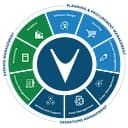
vCom Solutions: Centralize Your IT Lifecycle Management
vCom Solutions provides a comprehensive IT lifecycle management platform and managed services that help mid-market enterprises automate IT spend and operations.
Overview
vCom Solutions is a leader in IT lifecycle management, providing enterprises with the tools and expertise necessary to manage the full spectrum of their technology investments. Founded in 2001 and headquartered in San Ramon, California, vCom has evolved from a telecommunications management firm into a holistic IT spend and operations powerhouse. The company serves mid-market and enterprise-level organizations across various industries, including healthcare, retail, finance, and manufacturing, helping them navigate the complexities of modern IT environments.
vCom’s core value proposition revolves around its "vManager" platform, a sophisticated software suite designed to manage the entire lifecycle of IT assets—spanning network, mobile, cloud, hardware, and SaaS. This software is complemented by a robust suite of managed services, including professional procurement, project management, and expense management. By combining automation with human intelligence, vCom enables organizations to gain complete visibility into their IT spend, reduce operational overhead, and optimize their technology stacks for better performance and lower costs.
With over two decades of experience, vCom has built an extensive ecosystem of more than 450 service providers, giving their clients unparalleled access to the best technology solutions at competitive prices. Their market presence is defined by their ability to act as a strategic partner, simplifying the "noise" of IT management so that internal IT teams can focus on innovation rather than administrative tasks and billing disputes.
Positioning
vCom positions itself as the "Strategic IT Lifecycle Management" partner for the mid-market. Their market strategy is built on the premise that IT leaders are currently overwhelmed by the explosion of decentralized technology—SaaS sprawl, complex hybrid cloud environments, and fragmented mobile workforces. vCom differentiates itself by moving beyond simple Telecom Expense Management (TEM) to offer a broader "IT Lifecycle Management" (ITLM) framework.
In terms of competitive positioning, vCom sits between two extremes: the high-cost, large-scale consultants (like Accenture or Deloitte) and the narrow, automated-only software tools. Their messaging focuses on "The Power of One"—one platform, one team, and one invoice—to solve the complexity of managing multiple vendors. They target the "Goldilocks" zone of enterprises: companies large enough to have complex IT needs but small enough to lack the massive internal headcount required to manage those needs manually.
Their brand positioning emphasizes three pillars:
- Visibility: Seeing everything in one place.
- Choice: Access to a vast marketplace of providers without being locked into one.
- Control: Giving IT and Finance leaders the data they need to make informed decisions.
By positioning themselves as an advocate rather than just a vendor, vCom builds high levels of trust, framing their platform not as an added cost, but as a self-funding engine of operational efficiency.
Differentiation
The centerpiece of vCom’s offering is vManager, a proprietary IT lifecycle management platform that is widely considered one of the most comprehensive in the industry. Unlike point solutions that focus solely on mobile device management or wireline auditing, vManager provides a "single pane of glass" view across six distinct IT pillars: Network, Mobile, Cloud, Collaboration, Hardware, and SaaS.
Key technical advantages include:
- Centralized Inventory & Asset Management: Automatically tracks every IT asset across the enterprise, linking them to specific contracts, locations, and cost centers.
- Automated Procurement: The platform features a built-in marketplace where users can shop, compare, and order services from hundreds of providers, significantly reducing the time spent on RFPs and vendor evaluations.
- Advanced Analytics & Reporting: vManager transforms raw billing data into actionable intelligence, offering granular visibility into spend patterns and identifying anomalies or "zombie" services that should be decommissioned.
- Integrated Workflow: The platform manages the entire lifecycle—from initial design and sourcing to implementation, support, and eventual decommissioning—within a single environment.
By consolidating these functions, vCom eliminates the "data silos" that typically plague IT and Finance departments, providing a level of data integrity and operational efficiency that manual spreadsheets or disconnected tools cannot match.
Ideal Customer Profile
vCom Solutions is ideally suited for mid-market to enterprise-level organizations that meet the following criteria:
- Company Size: Typically 250 to 5,000 employees, though they serve larger enterprises with complex distributed footprints.
- Industry: Highly effective for industries with multiple locations such as Retail, Healthcare, Manufacturing, Financial Services, and Professional Services.
- Technical Maturity: Organizations that have moved beyond basic spreadsheets but are overwhelmed by the volume of vendor invoices and the complexity of hybrid cloud/telecom environments.
- Budget Range: Organizations spending at least $20,000 - $50,000 per month across telecom, mobility, and cloud services.
- Team Composition: Companies where the IT team is "lean" and spends too much time on administrative tasks (billing, procurement, support tickets) rather than core technology initiatives.
Best Fit
vCom Solutions excels in the following scenarios:
- Complex Multi-Vendor Environments: When an organization struggles to manage dozens of different contracts, invoices, and support portals across multiple carriers (e.g., AT&T, Verizon, Comcast, AWS) simultaneously.
- Rapid Geographic Expansion: For companies scaling quickly that need to procure and install circuits, hardware, and mobile devices across new locations without hiring a massive internal procurement team.
- Cost Containment Initiatives: When a business needs to immediately identify "ghost" services, billing errors, or over-provisioned assets to reduce OpEx.
- IT/Finance Alignment: When there is a disconnect between IT's technical inventory and Finance's accounts payable, vCom provides a single source of truth that reconciles both.
Offerings
vCom categorizes its offerings based on the lifecycle stage of the technology:
- vManager Platform: The core SaaS application provided to all customers to track assets, expenses, and tickets in one place.
- Buyers' Club: A procurement service that leverages vCom’s collective buying power to secure wholesale-like pricing for individual mid-market customers.
- Managed Services (Quantum): An "as-a-service" model where vCom professionals act as an extension of your team to handle all moves, adds, changes, and deletions (MACD).
- Specialized Managed Mobility Services (MMS): A dedicated package for mobile device management, including procurement, provisioning, 24/7 end-user support, and device recycling.
- Cloud Management: Services specifically focused on analyzing and optimizing SaaS, PaaS, and IaaS spend (e.g., Office 365, AWS, Azure).
Get our evaluation of vCom Solutions
Our advisory team has deep experience with vCom Solutions. We'll give you an honest, independent assessment — including how they compare to alternatives and what to watch out for.
Request EvaluationBuying Guide: vCom Solutions
Everything you need to evaluate vCom Solutions — from features and pricing to implementation and security.
Introduction
Evaluating a Technology Lifecycle Management (TLM) partner is a critical step for organizations looking to gain control over their sprawling IT spend and infrastructure. vCom Solutions offers a unique hybrid of a sophisticated SaaS platform (vManager) and expert-led managed services designed to simplify the way businesses buy, manage, and pay for their technology.
This guide provides a comprehensive framework for IT and Finance leaders to evaluate vCom’s capabilities. You will learn about their core value proposition in consolidating complex vendor landscapes, the technical and business requirements for a successful rollout, and the specific use cases where vCom delivers the highest ROI. Whether you are struggling with "bill shock" from cloud services or the administrative burden of managing hundreds of remote office circuits, this guide will help you determine if vCom is the right strategic partner for your technology lifecycle.
Key Features
vCom’s value is delivered through its proprietary vManager platform and supporting professional services:
- Centralized Procurement (Shop): A unified marketplace to research, design, and purchase services across 500+ providers. This includes price benchmarking and contract negotiation handled by vCom experts.
- Inventory Management (Manage): A "single pane of glass" view of every circuit, mobile device, cloud instance, and hardware asset, including serial numbers, MAC addresses, and physical locations.
- Expense Management (Pay): Automated invoice processing that includes GL coding, dispute management, and consolidated billing. vCom pays the vendors on your behalf, reducing hundreds of checks to one.
- Advanced Analytics: Real-time dashboards showing spend trends, cost-per-employee, and predictive modeling for future technology investments.
- Managed Support: A dedicated 24/7/365 Operations Center that handles trouble tickets across all vendors, acting as the single point of contact for outages and repairs.
- Mobile Management (EMM/MDM): End-to-end lifecycle for mobile assets, from procurement and kitting to recycling and policy enforcement.
Use Cases
- Scenario 1: The "One-Person" IT Department: A mid-sized manufacturing firm with 20 locations has one IT Director. vCom takes over the management of 20 different internet bills and 150 mobile lines, freeing the Director to focus on strategic projects rather than paying bills and calling ISPs for outages.
- Scenario 2: M&A Integration: A healthcare company acquires a smaller clinic group. vCom is used to quickly audit the new entity's disparate technology stack, identify redundant circuits, and migrate all assets into a single management portal within 30 days.
- Scenario 3: Mobile Workforce Management: A construction firm with 500 field workers struggles with lost devices and high roaming charges. vCom provides a managed mobile solution where they kit, ship, and support the devices, while using vManager to enforce data usage policies and optimize monthly plans.
- Scenario 4: Cloud Cost Control: A software company sees its AWS and Azure bills spiraling. vCom provides visibility into cloud spend alongside traditional telecom spend, helping the finance team allocate costs to specific products and departments accurately.
Pricing Models
vCom typically employs a transparent pricing structure based on the scope of management:
- Platform Fee: A monthly recurring fee for access to the vManager SaaS platform, often tiered based on the volume of assets or total spend under management.
- Managed Services Fee: Usually calculated as a percentage of the total technology spend being managed or a flat per-invoice/per-device fee.
- Professional Services: One-time fees for initial audits, complex migrations, or custom software integrations.
- Shared Savings: In some audit scenarios, vCom may work on a "contingency" basis where they take a percentage of the recovered credits from carrier billing errors.
- Included Value: Most tiers include a dedicated Account Manager and access to the 24/7 support desk without per-incident charges.
Technical Requirements
vCom is a cloud-native solution with minimal on-premise infrastructure requirements:
- Browser Support: Optimized for the latest versions of Google Chrome, Microsoft Edge, and Safari.
- Mobile Access: vManager app is available for iOS and Android for on-the-go asset tracking and approvals.
- Network: Standard broadband internet access; no specialized hardware or local servers required.
- Email: Integration with corporate email (SMTP) for automated alerts and reporting notifications.
- Data Import: Ability to export data from current carriers in digital formats (PDF, CSV, or EDI 810/811) for initial ingestion.
Business Requirements
To maximize the value of vCom, organizations should meet the following prerequisites:
- Centralized Decision Making: A designated project lead (typically in IT or Finance) who has the authority to consolidate vendor relationships and approve contract changes.
- Historical Data Access: Ability to provide at least 3-6 months of historical billing data and existing contracts for the initial audit and baseline phase.
- Process Readiness: Willingness to transition from manual, spreadsheet-based tracking to an automated lifecycle management platform.
- Stakeholder Buy-in: Alignment between IT (who manages the tech), Procurement (who manages the buy), and Finance (who pays the bills) regarding the use of a third-party managed service provider.
- Training Commitment: While vCom provides managed services, internal admins should be prepared to spend 4-8 hours in training to navigate the vManager platform effectively.
Implementation Timeline
A typical vCom implementation follows a phased approach over 90 days:
- Phase 1: Discovery & Data Collection (Weeks 1-3): Gathering all current invoices, contracts, and inventory lists. Setting up the vManager environment.
- Phase 2: Audit & Baseline (Weeks 4-6): vCom analysts identify billing errors, out-of-contract services, and optimization opportunities.
- Phase 3: Migration & Integration (Weeks 7-10): Directing carrier invoices to vCom’s processing center, establishing API links with ERP/AP systems, and importing mobile device data.
- Phase 4: Training & Go-Live (Weeks 11-12): Final platform walkthroughs for IT and Finance users, setting up automated reporting, and launching the first monthly payment cycle.
- Note: Timelines can vary based on the number of carriers and the cleanliness of the client's existing data.
Support Options
vCom provides a high-touch support model that distinguishes it from pure software vendors:
- Dedicated Account Team: Each client is assigned a dedicated Account Manager and a Solution Engineer for strategic planning.
- 24/7/365 NOC: A US-based Network Operations Center that manages carrier outages and technical issues on the client's behalf.
- vCom University: An extensive online learning management system with video tutorials and documentation for the vManager platform.
- Quarterly Business Reviews (QBRs): Scheduled strategic sessions to review spend data, optimization opportunities, and technology roadmaps.
- Implementation Support: A dedicated project management team handles the entire onboarding process, including data migration and carrier notifications.
Integration Requirements
vCom’s vManager platform is designed to sit at the center of the IT ecosystem with the following integration capabilities:
- Financial/ERP Systems: Pre-built and custom integrations with NetSuite, Oracle, SAP, and Workday to automate the flow of validated invoice data into accounts payable.
- ITSM Tools: Integration with ServiceNow or Cherwell to sync asset data and streamline trouble ticket management.
- Carrier Direct APIs: Deep integration with major telecom and cloud providers for real-time provisioning, status updates, and automated billing retrieval.
- SSO/Identity Management: Support for SAML 2.0 and Okta for secure, centralized user access.
- Data Formats: Support for EDI, CSV, and XML for legacy system data exchange.
- Effort Level: Standard financial integrations typically require 10-20 hours of technical coordination between the client's IT team and vCom’s integration engineers.
Security & Compliance
vCom maintains enterprise-grade security standards to protect sensitive financial and infrastructure data:
- Certifications: SOC 2 Type II compliant, ensuring rigorous controls over data security, availability, and processing integrity.
- Data Residency: Primary data centers located in the United States with geo-redundant backups.
- Access Control: Role-Based Access Control (RBAC) within vManager, allowing administrators to limit visibility by department, location, or function.
- Encryption: Data is encrypted at rest and in transit using industry-standard TLS protocols.
- Privacy: GDPR and CCPA compliant data handling practices.
- Audit Trails: Comprehensive logging of all user activity and financial changes within the platform for compliance reporting.


Considering vCom Solutions?
Independent. Vendor-funded. Expert-backed.
We'll help you evaluate vCom Solutions against alternatives, negotiate better terms, and ensure a successful implementation. Our advisory services are funded through the vendor ecosystem — at no cost to you.