Vendor Independence Does Not Mean Lacking an Opinion

Vendor independence means an advisor evaluates technology options without bias toward any provider. It does not mean staying neutral. A vendor-independent technology advisor should still deliver a clear recommendation that reflects the buyer’s specific priorities, backed by evidence and an honest account of the trade-offs.
When evaluating enterprise technology, having more choices does not guarantee a better decision. Buyers already have plenty of input: a 2025 Gartner survey found that B2B buyers used an average of seven information sources during a recent purchase, and 45% used generative AI. Handing buyers a long list of vendors and leaving them to figure out the best fit on their own only adds to that burden.
The true value of independent advice is not in avoiding opinions, but in the ability to justify and defend them. Beyond simple access to technology partners, organizations need help prioritizing their goals, understanding key trade-offs, and choosing a path forward with confidence.
What is the Difference Between Vendor Independence and Neutrality?
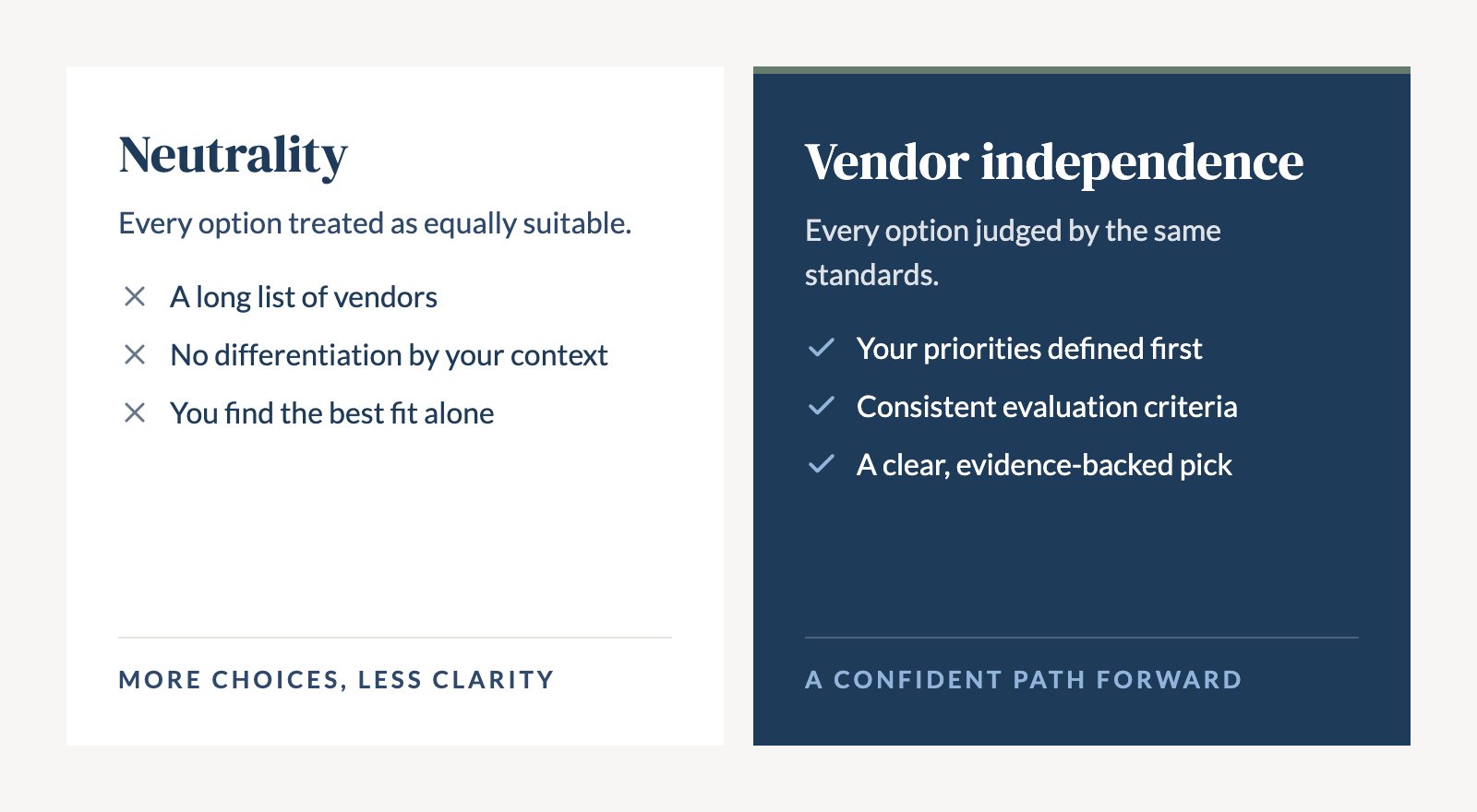
Though often used interchangeably, independence and neutrality mean very different things in a technology evaluation.
- Vendor independence involves an advisor evaluating competing options objectively, without favoring a predetermined vendor from the start.
- Neutrality, when understood as the practice of regarding every available option as equally suitable, fails to offer substantive value to the buyer because it neglects to differentiate between solutions based on the buyer's unique needs and context.
Organizations do not need every vendor to receive a glowing assessment. They need a thorough evaluation that reflects their specific needs and applies consistent standards. That process naturally leads to a clear preference for one solution over others.
An advisor can remain fully objective about the evaluation methodology while holding a strong position on the outcome. The credibility of that position comes from solid supporting evidence, such as industry benchmarks, relevant case studies, in-depth pilot testing, and ROI analysis tailored to the client’s goals, rather than prior bias.
Start With the Decision, Not the Vendor
Technology evaluations usually start by gathering requirements, reviewing platforms, comparing feature lists, and scheduling demonstrations.
Although essential, these activities are only effective when the organization first defines what the technology must achieve.
For example, consider a healthcare provider selecting a new communications platform. Key criteria might include system reliability, integration capabilities, security compliance, support for remote teams, and a smooth deployment process. While all requirements matter, they are rarely equal in priority.
A feature-packed platform may look impressive during a demo, but if it adds operational friction or fails to support a critical workflow, those additional features offer little real-world value.
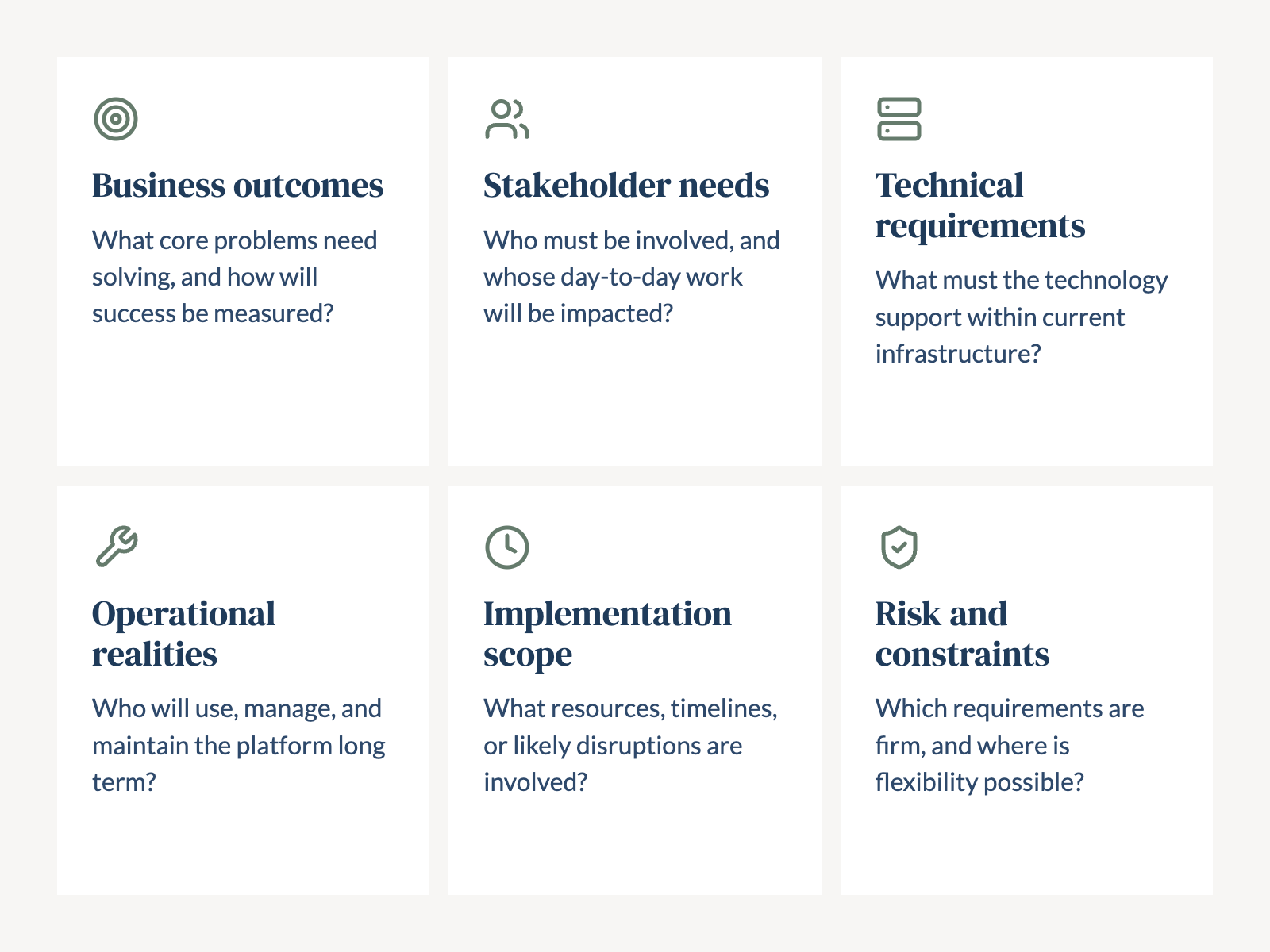
An effective recommendation focuses on what matters most:
- Business outcomes: What core problems need to be solved, and how will success be measured?
- Stakeholder needs: Who must be involved, and whose day-to-day work will be impacted?
- Technical requirements: What must the technology support within the current infrastructure?
- Operational realities: Who will use, manage, and maintain the platform long term?
- Implementation scope: What resources, timelines, or likely disruptions are involved?
- Risk and constraints: Which requirements are strict prerequisites, and where is flexibility possible?
The goal is not to build the longest possible list of requirements, but to determine which factors should carry the most weight when comparing alternatives. For a practical set of questions to guide that conversation, see how to build transparent alignment during the buying cycle.
Sound Advisory Requires Judgment
Trade-Offs Are the Norm
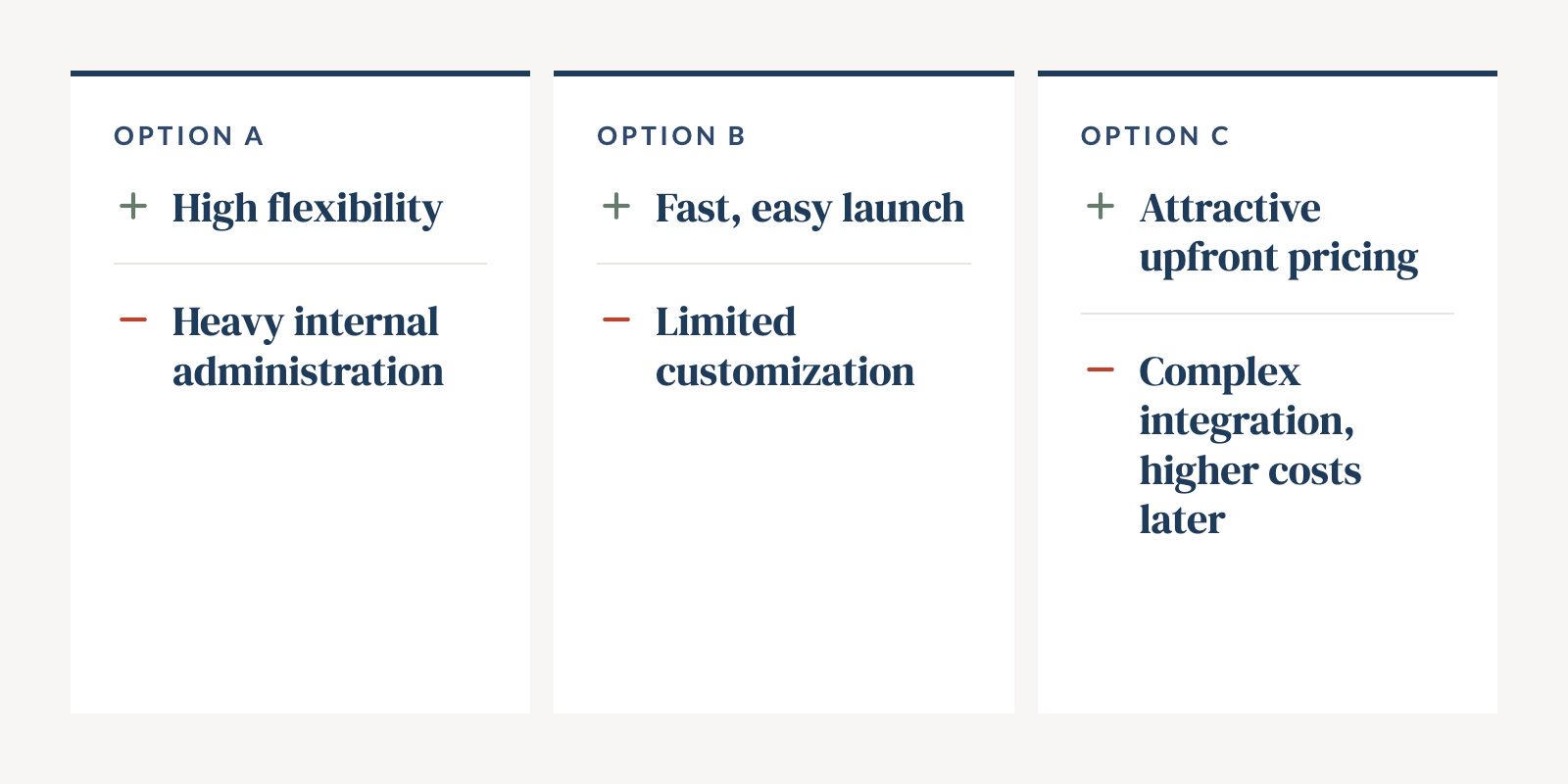
Enterprise technology choices rarely yield a single solution that leads in every metric.
One platform might offer high flexibility but demand heavy internal administration. Another may be easy to launch but lack deep customization. A third might provide attractive upfront pricing while introducing complex integration needs or higher operational costs later on.
Interpreting Trade-Offs in Practice
An effective advisor helps buyers interpret what these trade-offs mean in practice.
This approach goes beyond repeating vendor messaging; it calls for careful analysis of how each option's strengths and weaknesses align with organizational priorities.
For example, consider a regional hospital system assessing electronic health record (EHR) platforms. Such an organization might value efficient integration with existing patient care systems and strong data privacy protections above other considerations such as user interface customization. In this scenario, an advisor could recommend a vendor known for robust interoperability and stringent HIPAA Security Rule compliance, and explain why these attributes take precedence over alternatives that offer more customizable interfaces but have less proven regulatory safeguards.
Similarly, in the finance sector, a bank looking to modernize its loan origination system might prioritize seamless integration with legacy core banking applications, robust security features to comply with financial regulations, and automated audit trails. An advisor may recommend a solution that excels in these areas and clearly articulate how this choice outweighs other platforms that might offer a more modern interface but lack the necessary compliance certifications or integration capabilities.
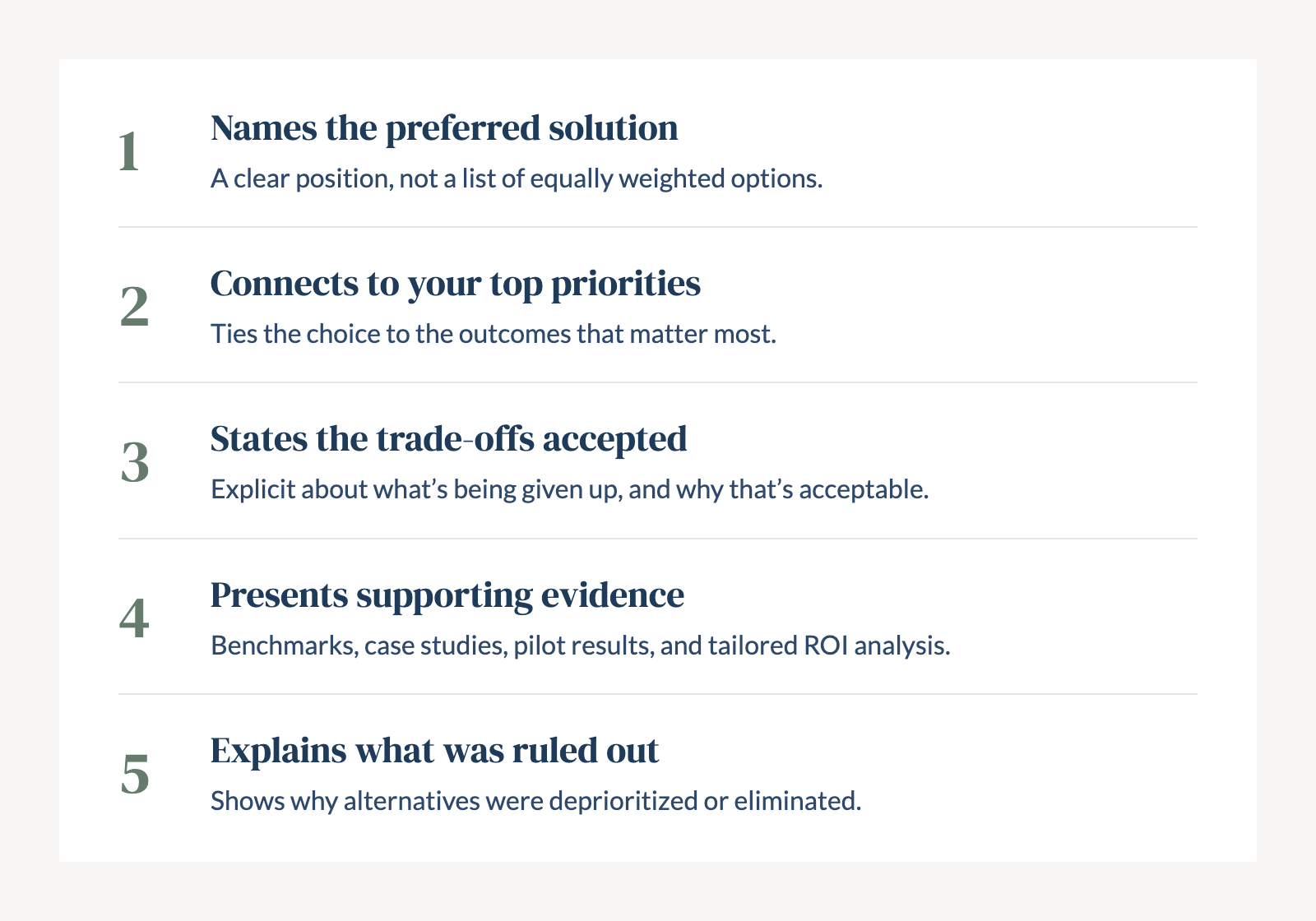
A strong recommendation must, therefore, specify why one solution is favored, which trade-offs are accepted, and what supporting evidence underpins the decision.
Explaining What Was Ruled Out
A strong recommendation should also clearly explain why alternative options were ruled out or deprioritized.
Objectivity and decisive recommendations are not mutually exclusive. A clear position is the direct result of a thorough evaluation process.
Independence Should Deliver Clarity
Vendor independence allows advisors to evaluate solutions free of bias. However, market access is only part of the equation. Buyers also need an advisor who can challenge core assumptions, separate core capabilities from promotional fluff, and identify areas that need deeper verification.
Sometimes this results in choosing a preferred vendor. In other cases, the most valuable outcome is narrowing the options, validating technical dependencies, refining assumptions, or building a stronger business case first. Regardless of the specific result, success is measured by the increased decision confidence, improved stakeholder alignment, and the organization’s ability to move forward with clarity. The goal is not always an immediate vendor selection, but a clear, well-supported path toward the right choice. That is the difference between simply listing options and offering true strategic guidance.
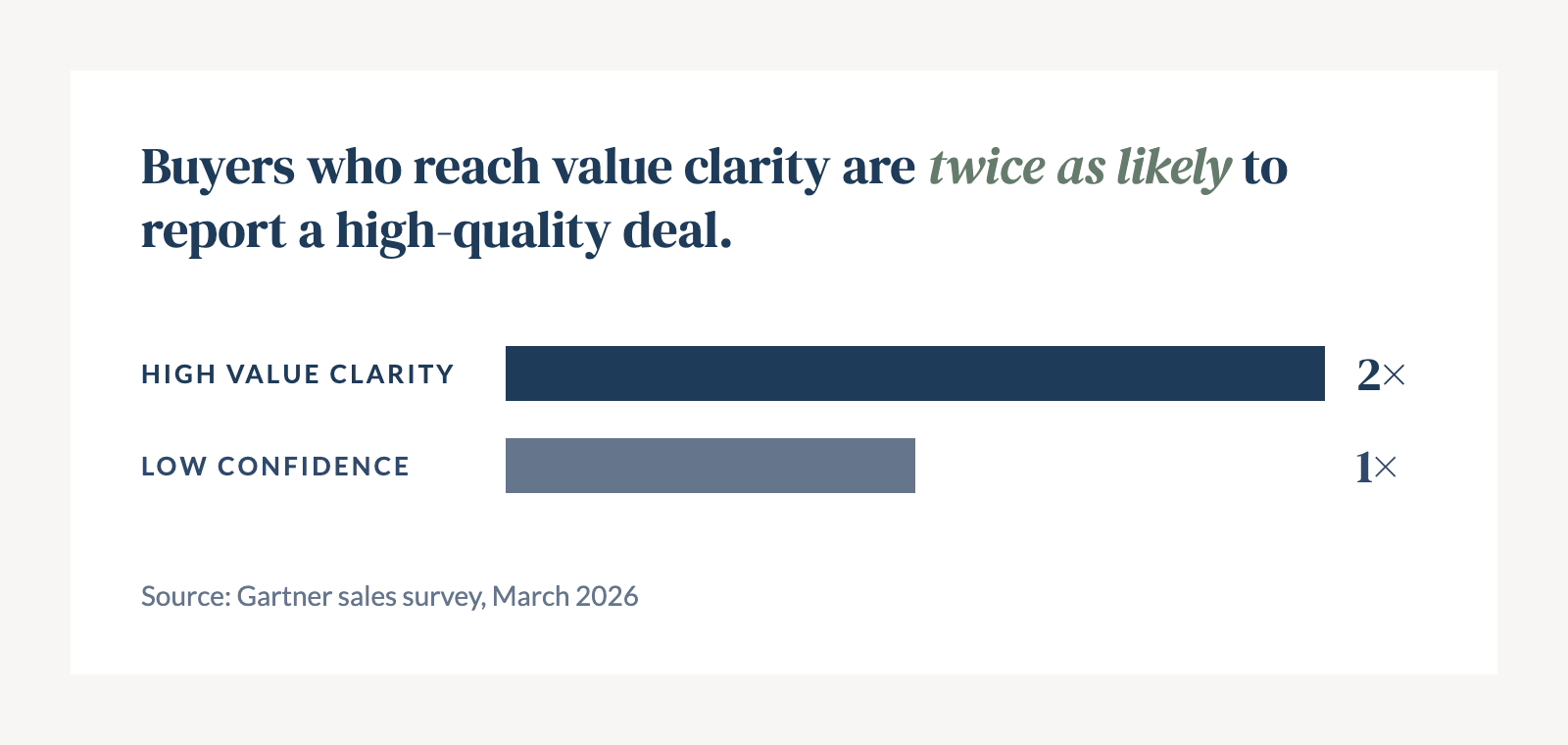
The payoff is measurable. Gartner research found that buyers who reach value clarity, meaning they clearly understand how a solution improves outcomes in their own role and business context, are twice as likely to report a high-quality deal as buyers with low decision confidence.
A strong recommendation does not ask buyers to accept an opinion on trust; it provides the rationale to verify it.
Frequently Asked Questions
What is a vendor-independent technology advisor?
A vendor-independent technology advisor evaluates technology solutions objectively, without ties that favor a particular provider. Independence shapes how options are evaluated, not whether the advisor makes a recommendation.
Is vendor independence the same as neutrality?
No. Vendor independence means evaluating every option against the same standards without a predetermined favorite. Neutrality treats every option as equally suitable, which leaves the buyer without a clear direction.
Should an independent advisor recommend a specific vendor?
Yes, when the evidence supports it. A good independent advisor recommends the solution that best fits the organization’s priorities and explains the reasoning, the trade-offs, and the evidence behind that choice.
What should a strong technology recommendation include?
A strong recommendation names the preferred solution, connects it to the organization’s top priorities, states which trade-offs are being accepted, presents supporting evidence, and explains why alternatives were ruled out or deprioritized.
What if the right next step is not choosing a vendor?
Sometimes the most valuable outcome is narrowing the shortlist, validating technical dependencies, or building a stronger business case first. The goal is decision confidence and a clear path forward, not a rushed vendor selection.
About the Author
Joe Rice
Chief Executive Officer
Joe Rice is CEO of CXponent. Throughout his career, Joe has focused on IT, communications, and networking infrastructure advisory and implementation services. He specializes in vendor evaluation and assessment and is recognized as a key advisor to both Gartner’s and G2’s top vendors. He helps technology providers enhance their transformation delivery, managed services, and partner programs. Prior to founding CXponent, Joe Rice co-founded a two-time INC 5000™ professional services firm. The innovative advisory firm helped enterprise business leaders transform legacy contact center, networking infrastructure, and phone systems into cloud-based, omni-channel communications platforms.
Need help navigating your technology decisions?
Our advisory team helps you evaluate, negotiate, and implement — at no cost to you.
Talk To Us