Overcoming Customer Reluctance to Interact With AI

A few weeks ago, I was reading through a forum for business owners that I belong to. One of the members posed the question, “As a customer, how do you feel when you call a business and an AI voice answers instead of a person?” Here’s just a sampling of the answers:
The circles, me having to repeat myself, and it hanging up on me? Nope
I absolutely hate AI phone systems. I want to talk to someone directly that has inside knowledge of the business and why I am calling.
If the AI is upfront, helpful, and gets me where I need to go quickly, I don’t mind really. The frustration usually comes when it pretends to be a human or blocks access to a real person.
If I’m booking a table reservation or seeking basic support for general services, no problem. If I’m using a SaaS or talking to my bank support and I’ve already expressed twice in the chat that I want to talk to a human and they keep asking me all these questions instead of connecting me then I’m a bit annoyed.
There was a lot more conversation, but some key themes surfaced from this discussion of business owners. The overall impressions expressed were that AI:
- Pretends to be a human and blocks access to real humans
- Requires people to repeat themselves
- Doesn’t know anything about the customer or why they are contacting the business
In every complaint, the root cause was not AI. It was how humans decided to configure AI.
These decisions lead to poorly designed customer experiences that just happened to be powered by AI. In this article, we will walk through three key decision areas to help you avoid choices that result in a poor customer experience.
Stop Pretending
The industry is at an interesting inflection point. High-quality, more human-like voices increase engagement, but customers also don’t want to feel like the AI is attempting to trick them into thinking it’s a human.
Finding the balance between increasing engagement and customers’ understanding that they are talking to AI is critical for improving customer sentiment towards AI self-service.
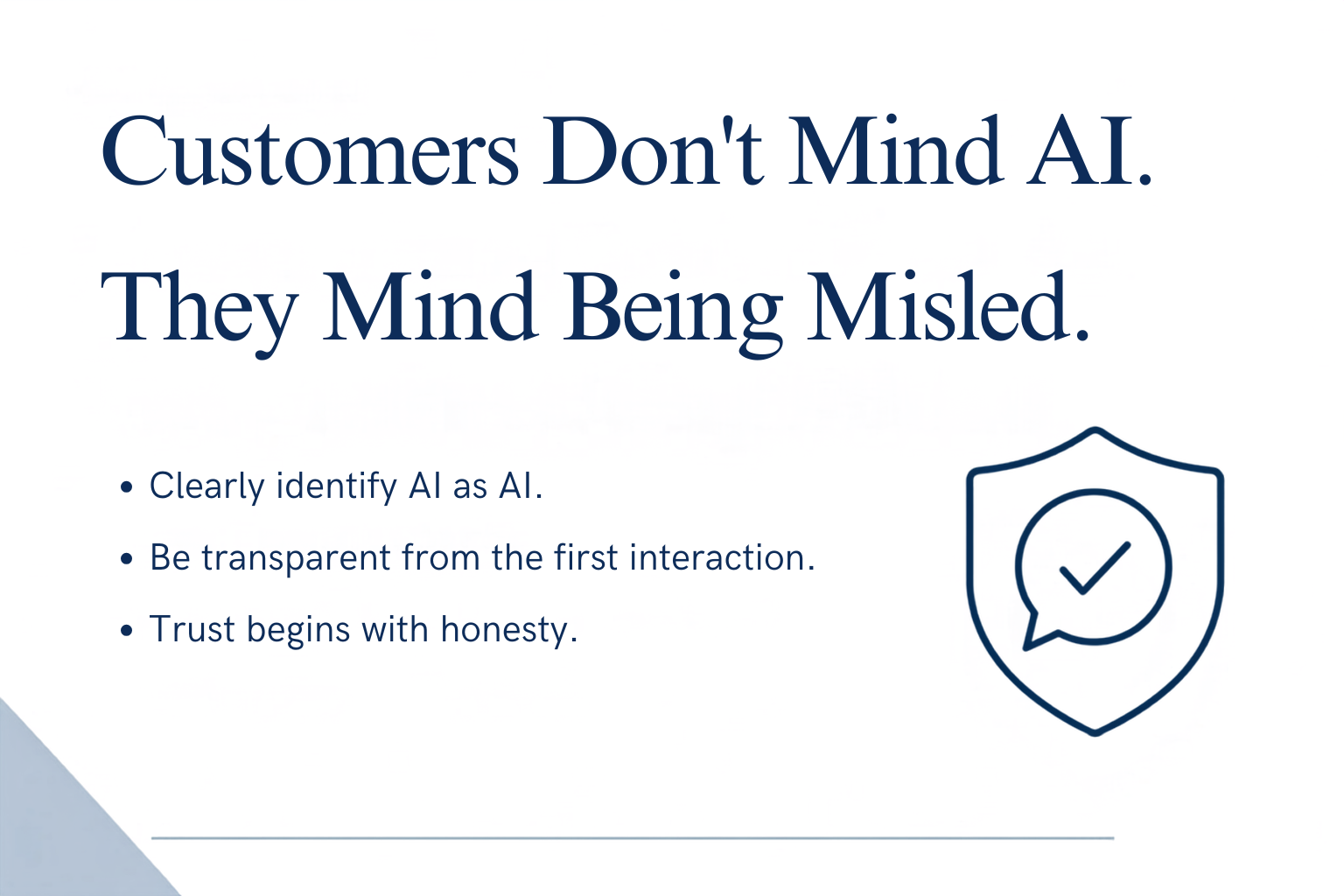
One of the simplest ways to avoid this impression is to have your AI self-service experience be open and honest about what it is. Instead of just stating the name of your AI agent, start your conversation or chat with a statement that it’s an AI assistant. So instead of:
Thank you for calling My Company. This is Juno. How can I help you?
Try:
Thank you for calling My Company. This is Juno, a virtual agent. How can I help you?
Being up front and honest is not only a better way to improve interaction with your customers, it’s rapidly being adopted as a legal requirement in many countries and US States.
While you’re being up front that the customer is interacting with an AI agent, this could be the opportunity for you to share additional information that may make customers more willing to interact with it, rather than hanging up or directly asking for an agent.
Here are a couple of examples of what that might look like:
Customers find that approximately 95% of their concerns can be resolved by interacting with the bot. What can I do for you?
I work with customers so our human agents can handle the really tough cases.
In the first option, you’re providing information to give contacts greater comfort that their issue will be resolved if they work with the bot. The second reassures them that they aren’t contributing to workforce reduction if they use the bot.
Ultimately, you need to choose the messaging that is both truthful and works for your customer base to help give them a level of comfort moving forward.
Focus on the Flow
Picture this: you’re interacting with an AI Agent, and you ask it a question. With its response, it’s clear it doesn’t know what you’re talking about, but you ask it again. It still provides an unsatisfying answer, so you ask it again and maybe change up the wording a little bit. It again provides an answer that doesn’t meet your needs.
What do you do?
If you’re like most people, you’ll probably ask for a human agent to help you. And if you get into a loop of asking for a human agent? You’re probably going to end up hanging up if you haven’t already.
Three primary actions can help reduce issues that prevent a customer from getting into an infinite loop:
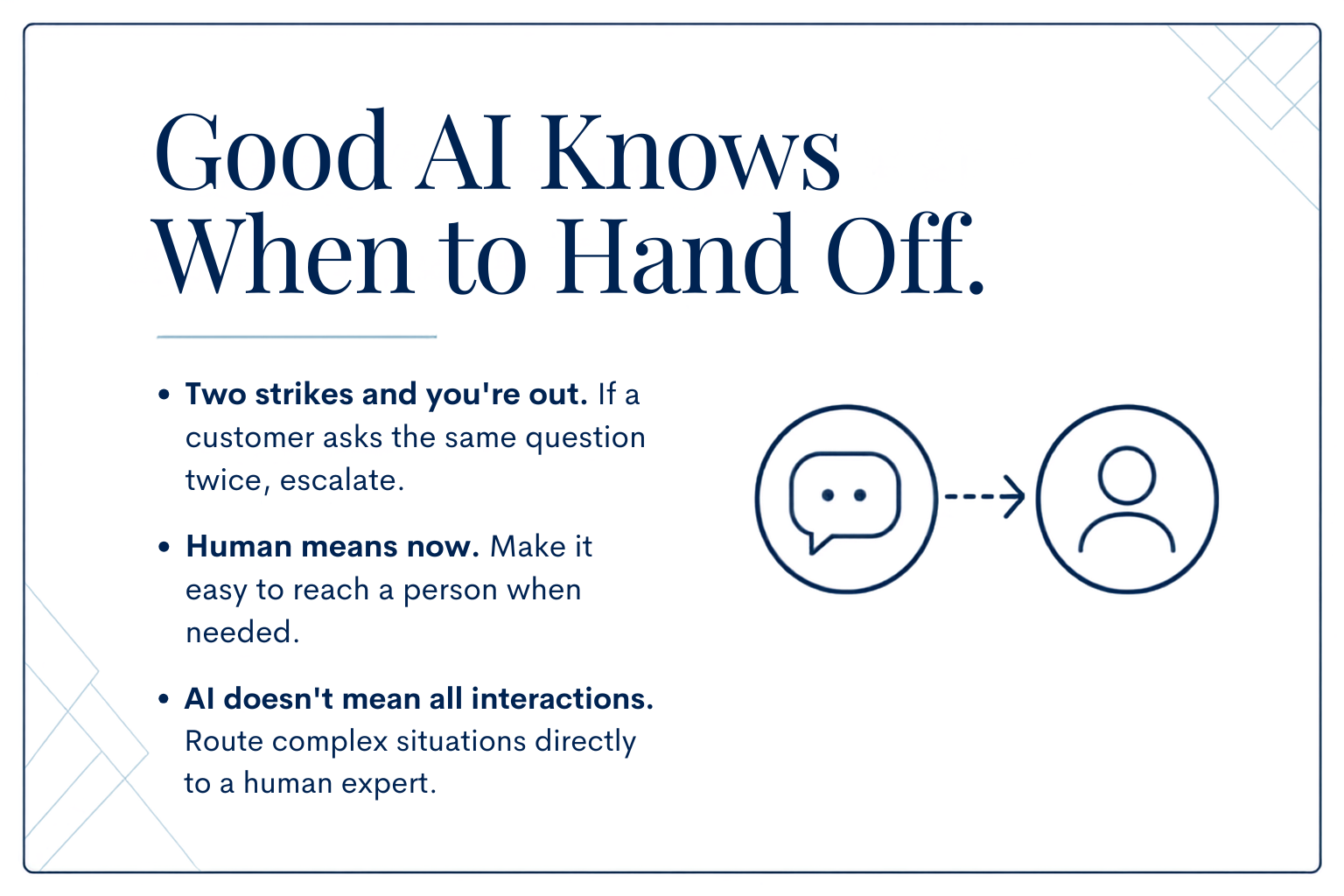
1. Two Strikes and You’re Out
If someone asks the same question twice in a row, it’s clear that they aren’t getting the answer that they are looking for. Rather than going for round three, just instruct your AI to proactively route to a human agent.
2. Human Means Now
Many organizations want to prevent calls going to human agents at all costs, but if you want to improve adoption of your AI agents, that’s not the way to go. By creating a frictionless way to get a human agent when needed, it will actually encourage customers to use the AI agent because they know that, should they need it, it’s easy to get ahold of a human.
3. AI Doesn’t Mean “All Interactions”
When you’re first determining how to build your AI agent, it’s just as important to understand the types of questions that the agent won’t answer as it is to understand what it will.
In cases where a customer is asking about something you’ve determined requires a human agent, immediately direct them to a human. This ensures that customers continue to receive a high level of service for those situations where the AI doesn’t actually know what it’s doing.
Understanding Data Requirements
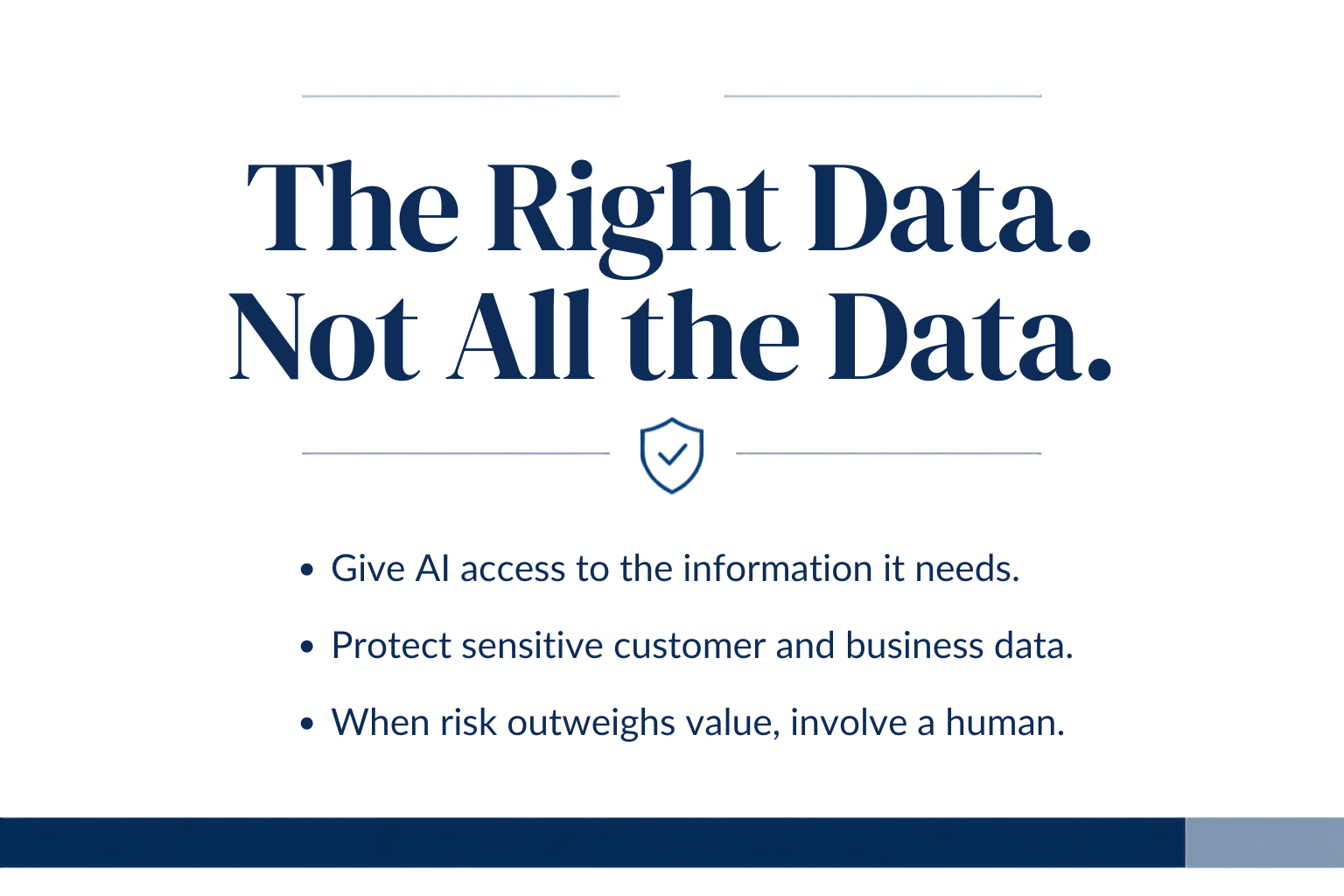
Organizations need to approach the question of data access for their AI agents carefully.
With too much access, your agent could accidentally share privileged customer information with the world when it shouldn’t. With too little access, it will be unable to answer customer questions.
Evaluating the data an AI agent needs access to and then determining the level of risk for providing that data is an important step when deploying a new AI agent. If you’re unwilling to take the risk of sharing certain data with an AI agent that’s essential for one of its functions, you have two options: either find a way to reduce the risk or decide that the function will be handled by a human instead.
Whether you’re talking about FAQs, order information, or account-level details, every organization needs to deliberately approach the process of determining what data is needed and whether that data is acceptable to share with the AI agent.
Wrap-up
Customers have real concerns about their interactions with AI agents. But as we’ve seen, AI is not the problem. Poor decisions in configuration and design are.
Overcoming customer reluctance starts with a human making intentional decisions that improve customer experience. Clearly identifying the agent as AI, creating well thought out interaction flows that result in a hassle free customer journey, and being strategic in identifying when and where to use AI all result in increasing customer trust of your AI agent.
CXponent can assist in planning and defining your AI customer experience to reduce your customers’ reluctance to interact with AI. Connect with us to determine the right path to build a customer-centric AI agent for your contact center.
About the Author
John Welsh
Technology Advisor
John Welsh is an AI Principal at CXponent where he specializes in transforming customer experience with applied artificial intelligence. Over the past decade and a half, John has helped organizations modernize the way they engage customers by pairing AI capabilities and technology with a customer and business outcomes driven focus.
Need help navigating your technology decisions?
Our advisory team helps you evaluate, negotiate, and implement — at no cost to you.
Talk To Us